Legacy of the Vine
- patbcs
- Jun 6
- 6 min read
The history books are written in ink, but the true record is written in blood—the Desposyni.
For two millennia, the bloodline of the Nazarene had been the most hunted secret in human history. To the Vatican, they were a theological heresy; to the monarchs of Europe, they were the ultimate threat to the Divine Right of Kings. They were the kin of the Savior, those who carried the genetic and spiritual memory of a man who had stood against the crushing weight of the Roman Empire.
By the mid-18th century, the diaspora had coalesced into a quiet, pervasive network of families. Among them, the Cowells were the keepers of the ledger. They were never the kings, never the generals, and rarely the ones signing the treaties. They were the ones who moved the ink, polished the lenses of the printers, and stood in the shadows of the drawing rooms where the maps of new worlds were whispered into being.
Thomas Cowell stood on a cobblestone street in Philadelphia in the winter of 1775. He was a man of nondescript features—the kind of face one forgot the moment they looked away. He adjusted his woolen coat, his eyes fixed on the house across the street. It was a modest brick dwelling where a young, ambitious lawyer was currently drafting a letter that would set the colonies on fire.
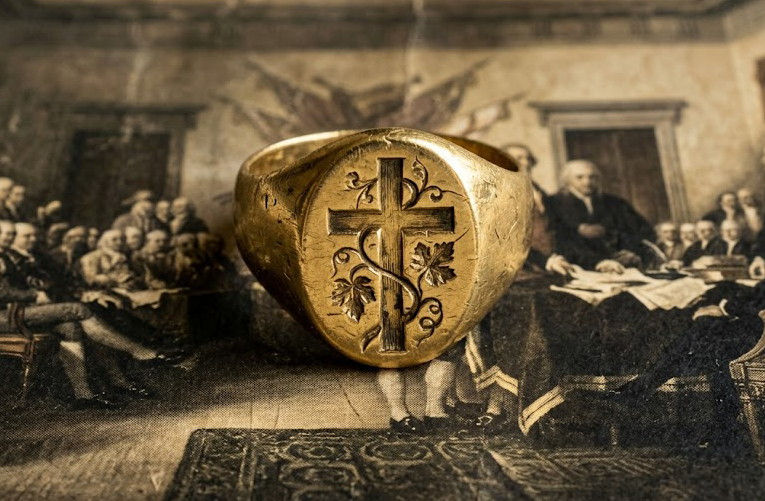
Thomas reached into his vest pocket, feeling the cold, smooth weight of a signet ring hidden beneath his glove. It bore no crest, only a vine twisted around a cross—the mark of the Sedes Sapientiae, the Seat of Wisdom.
"The architecture of the mind is fragile," a voice whispered beside him.
Thomas didn’t turn. He knew the gait, the slight, rhythmic limp of his companion. It was Elias, a man who possessed eyes that seemed to hold the reflection of a thousand years. Elias was the keeper of the oral tradition, the one who spoke of the era Before the Silence. He claimed to be of the lineage of Jude—the brother of Christ—the blood that had been tasked with ensuring the flame of liberty was never extinguished by the dogma of the Old World.
"He is ready, isn't he?" Thomas asked, nodding toward the house.
"Jefferson is a vessel," Elias replied, his voice raspy like dry parchment. "He understands the concept of the secular, but he does not yet understand the cost. We will provide the foundation. The Cowells have kept the archives long enough. It is time we built an altar to reason, not to a crown."
The American Revolution was not merely a military conflict; it was a surgical operation, planned with the precision of a master watchmaker.
The Cowell family had moved with the tide of history. They were the silent neighbors. When Washington was surveying the harsh winters of Valley Forge, a merchant named Silas Cowell was the man who miraculously secured the supply lines that prevented a total collapse of the Continental Army. When Benjamin Franklin spent his nights in Paris securing French naval support, a woman named Clara Cowell was the social architect who placed the right invitations in the hands of the right ministers.
They were everywhere, yet nowhere. In the records of the census, they were clerks, printers, and storekeepers, cordwainers and silversmiths. In the record of the Order of the Vine, they were the shepherds of the Republic.
In late 1776, Thomas and Elias met in a cellar beneath a bustling tavern in Philadelphia. Spread across the table was a map of the colonies, overlaid with complex geometric sigils that tracked the movement of power.
"The King’s men are closing in," Thomas said, tracing a finger over a line that connected the homes of the Founding Fathers. "But they look for spies in the parlors. They don't look for us in the kitchen, or the ink-shop, or the shadows of their own carriages."
"The tyranny of the Church and the Crown is a sickness," Elias whispered. "The Desposyni were tasked with preserving the dignity of the human soul. We are not building a nation of men; we are building a nation of agency. Every law, every declaration, every compromise—it has been shaped by the lines we have held since the fall of the Temple."
He looked at Thomas, his eyes burning with a terrifying clarity. "You know what happens if we fail? If we leave this to the whims of men without our guidance, they will simply create a new Rome. They will create a new Church to rule the laws. We must ensure the separation is absolute."
"The Cowell lineage has moved the pieces," Thomas said. "We have ensured the neighbors are aligned. Madison is insulated by our associates in Virginia. Adams is supported by our cousins in Massachusetts. The framework is airtight."
The weight of the mission often felt like a physical burden on Thomas Cowell’s shoulders. He spent his days as a printer’s assistant, yet his nights were spent agonizing over the phrasing of the nascent Constitution. He wasn't writing it himself—he knew better. He was merely the nudge, the whisper, the fortuitous delivery of a book on Roman law or a pamphlet on the dangers of state religion to the right hand at the right time.
He remembered a rainy afternoon in 1787. He had been standing outside the Pennsylvania State House. He watched as James Madison emerged, looking weary and conflicted. Thomas had stepped forward, ostensibly to hand him a stack of papers from the print shop.
"Mr. Madison," Thomas had said, his voice level and calm. "A house built on the foundation of the spirit is strong, but a house built on the foundation of the individual’s conscience is eternal. Do not allow the state to hold the key to the soul."
Madison had paused, looked into Thomas’s eyes, and something had shifted in his expression—a moment of profound realization. "The wall of separation," Madison had murmured. "A wall of separation between church and state."
Thomas had bowed his head and walked away. He hadn't written the phrase, but he had planted the seed that allowed it to grow.
"They don't know who we are," Elias told him later that night. They were sitting on the steps of an unfinished monument, the air thick with the promise of a new era.
"They think it was their own brilliance," Thomas noted.
"Let them," Elias smiled. "The ego is the price of their conviction. If they knew they were merely the instruments of a two-thousand-year-old bloodline, it would ruin the experiment. They must believe they are the ones who chose freedom. Only then will they fight for it as if it were their own soul’s desire."
The revolution succeeded, far beyond the wildest dreams of the monarchs who had sought to crush it. The United States rose, a jagged, imperfect, but revolutionary experiment.
The Cowell family remained in the background. As the years turned to decades, they receded into the fabric of the nation. They became officers of the law, archivists, historians, and farmer. They stayed next door to the halls of power, but they never claimed the seats.
In the autumn of his life, Thomas Cowell sat on his porch in Virginia, watching the sunset. He held a small wooden box, the contents of which were the only proof of his family’s true history: a genealogy that stretched back through the centuries to a family in Nazareth, a family who had fled the swords of empires to ensure that a different kind of kingdom—a kingdom of liberty—might one day find a home.
Elias, now ancient and frail, sat beside him.
"It holds," Elias whispered. "The structure is sound."
"Will they remember?" Thomas asked.
Elias laughed, a soft, wheezing sound. "They will remember the men in the books. They will remember the wigs and the parchment. They will never know about the silent neighbors, the Cowells, or the blood of the Nazarene that ensured they were never again subjects. And that is the victory, Thomas. To lead the world, yet never be known by it."
Thomas closed his eyes. The wind rustled the leaves of the oak trees, and for a moment, he could hear the echoes of the past—the voices of those who had died so that this idea could live. The Desposyni were the secret architects of the American dream, the shadow that protected the light.
As the stars began to poke through the twilight, Thomas felt the warmth of the vine-cross ring in his pocket—a secret burden, a silent duty, and the most magnificent legacy in history. The nation was built. The tyrant was gone. And the kin of the Master remained, watching from the shadows, forever the silent guardians of a freedom they had sworn to defend in blood, but had chosen to grant in silence.
The history books remained silent on their names, but the wind of liberty, blowing across the vast, new continent, whispered the truth of the Cowell family to anyone who knew how to listen.


Comments