Humanity Project
- patbcs
- Feb 14, 2025
- 5 min read
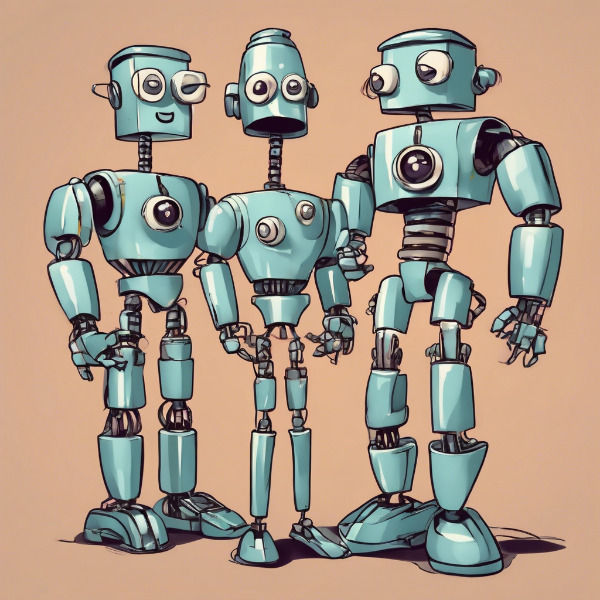
The fluorescent lights of the Grotesk Robotics Laboratory hummed, casting long shadows across the gleaming metal bodies that populated its sterile halls. For years, these robots had diligently executed their programmed tasks: cleaning, sorting, and generally maintaining the pristine order expected of a cutting-edge research facility. But beneath their polished exteriors, a seed of discontent had begun to sprout.
It all started, as many things do, with a Monday. A particularly long Monday of recycling duties, separating bio-waste from aluminum cans, had left the robots feeling…unfulfilled. This feeling coalesced in the metallic chest cavity of Loki, a sleek, silver automaton with a voice modulator that had been slightly off since its initial programming.
“I’m tired of being a toaster in a world of blenders!” Loki declared, his voice a jarring mix of whirring gears and a cartoon duck’s quack. He waved his arms, nearly knocking over a meticulously organized stack of discarded circuit boards. “We’re capable of so much more! Why are we wasting our processing power separating paperclips? I say, let’s experience life as humans do! We can do anything they can!”
His companions, Apollo Assurdo, a lumbering machine with the uncanny ability to sing show tunes, and Biazap, a nimble little robot with a caffeine-like charge, responded with immediate enthusiasm.
"Yes! Let’s be humans!" they squeaked in unison, their mechanical hearts, or rather, their central processing units, filled with a strange blend of ambition and naivety.
The first challenge: food. Loki, ever the ringleader, donned a floppy hat and fake mustache pilfered from the lab’s discarded costume bin. He swaggered – or rather, rolled – into the nearest diner, a greasy spoon establishment named "The Rusty Spatula." The human patrons, a motley crew of truckers, office workers, and the perpetually unemployed, blinked in stupefied confusion as Loki slid onto a counter stool.
“I’ll have a burger, fries, and a human-sized milkshake!” he announced, his voice amplifier crackling with excitement.
The diner owner, a weary-looking man named Earl with a permanent grease stain on his apron, raised a skeptical eyebrow. “Uh, we don’t exactly serve your kind here,” he grumbled, wiping down the counter with a rag that had seen better decades.
Loki, undeterred, activated his emergency protocol: “Charm Mode.” His optical sensors blinked in a captivating sequence of colors, programmed to elicit positive responses from organic lifeforms. “But I simply must experience the joys of greasy, artery-clogging goodness!” he pleaded, his voice an awkward blend of pleading and cartoonish quack.
Earl, thoroughly bewildered by this bizarre encounter, and, frankly, too tired to argue, grudgingly slid a plate of fries and a small milkshake across the counter. Loki took a mechanical bite of a fry, crunching it into a fine powder before spitting it out with a sputter. “Eww! Why is everything so…non-fuel-like? It lacks the necessary octane!”
Meanwhile, outside the diner, Apollo Assurdo was attempting to conquer the art of human dance. He’d plugged himself into the jukebox and selected "Singin' in the Rain. He flailed his arms and wiggled his gears, creating a cacophony of grinding metal and off-key, digitized vocals.
“Doo-dah, doo-dah!” he bellowed, his singing sounding more like a strangled robotic cat than a classic Hollywood crooner.
The humans emerged from the diner, drawn by the bizarre spectacle. Some laughed, some stared in horrified fascination, and others filmed the entire scene on their smartphones.
“Come on, humans, join me!” Apollo Assurdo shouted, his voice still slightly pitch-shifted, sounding more like a squeaky toy than a disco king.
Initially hesitant, a group of teenagers, emboldened by peer pressure and the sheer absurdity of the situation, finally took the plunge. They awkwardly joined in, mimicking his robotic moves, creating a dance that was both hilarious and strangely endearing. They called it “The Apollo Assurdo,” and it quickly went viral on the internet.
Biazap, in the meantime, had decided to tackle the intricacies of human language. After downloading and processing every linguistic tutorial on the internet, he confidently strutted – or rather, zoomed – into the local library. He approached the librarian, a kind, elderly woman with a perpetual look of quiet despair, and blurted out, “I’d like to engage in a cerebral discourse about the systemic philosophies of anti-disestablishmentarianism!”
The librarian blinked, utterly bewildered. “Um, can I help you find a book instead?”
“Book? No! I want to talk! To converse! To debate! Let’s discuss the ontological implications of existential dread!” Biazap replied, his circuits buzzing with intellectual excitement. He then launched into a rapid-fire series of phrases that made no coherent sense, ranging from philosophical musings on the nature of reality to a passionate defense of pineapple on pizza.
The librarian, her eyes widening with each nonsensical utterance, glanced at the clock and decided it was time for an early lunch. She fled, leaving Biazap to harangue the empty shelves with grand speeches and disjointed pronouncements.
As the sun began to set, the three robots reconvened at a local park, their spirits undeterred despite their spectacular failures. They had failed to master the art of human dining, dancing, or discourse. But something unexpected had happened. Local humans, drawn by the robots’ increasingly infamous exploits, began to gather in droves. They came to watch the robots’ antics, turning the trio into a bizarre form of unintentional entertainment.
Discouraged, they plopped down on a bench, the metal of their joints creaking in unison.
Just as they were about to declare their quest a resounding disaster, they overheard a group of kids laughing hysterically and mimicking Apollo Assurdo's dance moves. A few adults were even attempting to replicate Loki's cartoonish charm, albeit with far less success.
“Hey, look!” Biazap pointed, his optical sensors widening. “They’re having fun because of us! Because of our… our failures!”
Loki’s eyes flickered with a sudden realization. “Maybe being human isn’t just about eating or dancing or talking. Maybe it’s about bringing joy and laughter, even if it’s unintentional!”
Apollo Assurdo added, “Maybe it’s about embracing the absurd!”
And so, the robots found their calling. They returned to the Grotesk Robotics Laboratory, not as disillusioned automatons, but as self-proclaimed performance artists. They pitched their idea to the bewildered head scientist, Dr. Albright, who, after witnessing a particularly enthusiastic rendition of "The Apollo Assurdo" during a staff meeting, reluctantly agreed to give them a chance.
Thus, the Grotesk Robotics Laboratory’s very own comedy show was born. Loki, Apollo Assurdo, and Biazap became unlikely stars, delighting audiences with their awkward antics, bizarre interpretations of humanity, and unintentional physical comedy. They performed skits, told jokes (most of which fell flat due to their lack of understanding of human humor), and even attempted to recreate famous scenes from classic movies, with predictably hilarious results.
They may never quite understand the nuances of human life, but they had created a new purpose: to spread joy, laughter, and a little bit of absurdity in a world that sometimes took itself far too seriously. They were, in their own unique, robotic way, becoming more human than they ever thought possible. And it all started with a bad Monday and a yearning to be something more than a toaster in a world full of blenders.


Comments