Genocide Comet
- patbcs
- Sep 6, 2025
- 14 min read
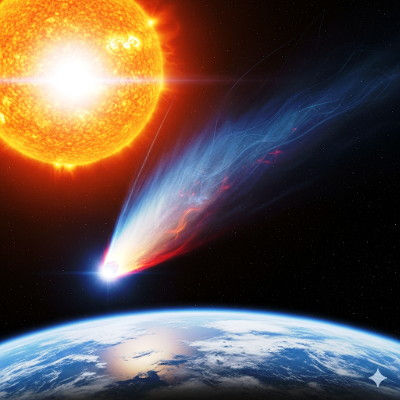
The dying light of Agusta cast long, skeletal shadows across the High Council chambers. For a thousand years, they had searched, their vast, advanced civilization teetering on the precipice of collapse. Their planet, once a verdant jewel, was now a parched, overcrowded husk, its resources long plundered, its skies choked with the industrial miasma of a struggling empire.
High Elder Evander, his elongated form a study in weary elegance, traced the lines of a holographic projection with a multi-jointed digit. His species, the Agustaramia, possessed minds that processed data at impossible speeds, yet even their collective intellect had failed to find a solution. Their eyes, like polished obsidian, stared at holographic projections of distant stars, each one a dead-end, their calculated probabilities of sustaining Agusta dwindling to zero.
Until Earth.
Earth, a vibrant blue marble teeming with nascent intelligence, had been observed for centuries. A quaint, developing world, its inhabitants blissfully unaware of the hungry eyes watching from afar. For millennia, the Agustaramia had held back, adhering to ancient tenets of non-interference. But the time for such niceties was over. Agusta was dying, and its people, tens of billions of them, would not perish without a fight.
The decision, whispered by the High Council with a heavy, collective sigh, was agonizing in its necessity, chilling in its execution. High Elder Evander’s voice, a low resonance of harmonic tones, finally broke the silence. "The calculations are precise. The probability of success… well above acceptable. The moral cost…" He paused, his gaze sweeping across the somber faces of his peers. "Irrelevant, when faced with extinction." Earth’s life was expendable.
Their plan was audacious, horrific, and meticulously calculated. From the dark, frozen fringes of their own solar system, they selected a proto-comet, a colossal ice ball the size of a small moon. Project ‘Novagenesis,’ as it was code-named, commenced. Through monumental feats of gravitational manipulation and propulsion – harnessing the raw energy of captured stellar winds and dark matter singularities – they began the arduous process of nudging it, slowly at first, then with accelerating intent, towards Earth’s sun. The aim was not impact; a direct hit would render the planet uninhabitable, useless for colonization. Instead, the comet was engineered to slingshot past the sun, its icy mass shedding a vast, glittering trail of debris into Earth’s orbital path.
But this cosmic dust was no mere inconvenience. Deep within the comet’s core, a hidden payload had been carefully cultivated. A biopathogen, specifically designed to target the unique genetic markers of Earth’s dominant human population, much of its animal life, and a significant proportion of its flora. It was designed to devastate, to cleanse, to sterilize the planet of its inconvenient inhabitants, leaving a fertile, if scarred, world ready for the Agustaramia. The bio-engineers, their faces etched with the strains of their grim task, had fine-tuned it over decades, ensuring its virulence, its specificity, and its environmental persistence. It was the perfect blight, a silent, invisible tide of oblivion.
On Earth, the astronomical community buzzed with excitement. “The Interstellar Wanderer,” they called it, a spectacular, unprecedented visitor. Dr. Felix Wicklund, head of the Global Stellar Astro-Observation Network, stared at the deep-space telemetry from his console in Geneva. The comet, designated C/2057 A1, was a marvel. Its trajectory was anomalous, a perfect hyperbolic curve that would take it within an astonishingly close proximity to the sun before swinging back out into the Kuiper Belt.
"Never seen anything like it," Felix murmured to his team, his voice hushed with awe. "It's like something out of a textbook, a perfect gravitational ballet."
Telescopes across the globe were trained on the approaching comet, its distant, icy tail growing more luminous with each passing month. Scientists marveled at its trajectory, noting its close approach to the sun, an event that promised unparalleled data, a celestial spectacle of a lifetime. Citizen scientists, amateur astrophotographers, and even children with backyard telescopes tracked its progress. News channels ran daily updates, showing stunning simulations of its solar flyby. No one, not a single soul, suspected malevolence. It was a novelty, a wonder, a scientific goldmine. Humanity, in its innocent fascination, was mesmerized by the beautiful, approaching harbinger of its own demise.
Unseen, unknown, a vast fleet of Agusta colony-building spacecraft, veritable cities in space, followed a year behind the comet. Their journey was long, a slow, inexorable crawl through the void, powered by a patient, calculating desperation. Each vessel pulsed with millions of Agustaramia in stasis, their dreams of a new home suspended in cryogenic sleep. But the prize at the end – a new, pristine world – made every light-year endured worthwhile. They were traveling towards a silent, empty cradle.
The disaster struck with an almost poetic elegance. As Earth passed through the shimmering, diffuse debris left by the comet’s solar flyby, the microscopic spores of the pathogen, awakened by the warmth of the sun and the rich atmosphere, began their deadly work.
It started subtly: a faint, persistent cough, dismissed as a new strain of influenza, a fever that wouldn’t break, a strange wilting of crops in isolated, impoverished regions. Dr. Amara Awbrey, a renowned virologist at the CDC’s Atlanta campus, initially saw it as an unusual, but manageable, health crisis. Her genome sequencing team worked feverishly, but the pathogen’s structure was unlike anything they’d ever encountered – a synthetic marvel of biological engineering.
Then, it exploded. The pathogen, insidious and swift, tore through human populations with terrifying speed. The incubation period was short, the symptoms aggressive. Respiratory failure, systemic organ collapse, a rapid degradation of the neural pathways. Hospitals overflowed, unable to cope with the sheer volume of the sick. Cities became ghost towns, their once bustling streets echoing with an eerie silence punctuated only by the distant wail of emergency sirens that eventually, too, fell silent. The global communication networks, once vibrant, fell silent, piece by agonizing piece, as the operators succumbed, or simply had no one left to contact.
Dr. Awbrey watched, horrified, as her own team dwindled, as her colleagues, then her friends, fell ill. She saw the familiar faces of meteorologists on the news, their voices hoarse, their eyes red-rimmed with fever, before their broadcasts abruptly cut out. Animals succumbed with harrowing speed, their cries echoing through deserted forests, their bodies lying still in fields. Even the plants, the silent witnesses, showed signs of blight, their leaves curling, their life forces draining away, turning once lush landscapes into skeletal husks. The world was dying, and humanity was powerless to stop it.
Panic turned to despair, and despair turned to desperate resolve. Earth's scientific community, reeling from the initial shock and the immense personal losses, united with an unprecedented fury. The remaining government structures, skeletal and fractured, funneled all resources into the labs that still functioned. Powered by grief and an unshakeable will to survive, geneticists, virologists, botanists – they scoured the planet’s remaining biodiversity, racing against the clock of extinction. Humanity’s innate tenacity, forged over millennia of struggle, flared in the face of oblivion.
In record time, breakthroughs came. Fueled by a desperate, rapid-fire exchange of data, often transmitted by lone operators from abandoned stations, Dr. Awbrey’s team, now a fraction of its original size, working alongside other scattered pockets of brilliant minds, synthesized an antiviral. It wasn't a cure, but it arrested the progression, giving the body a fighting chance. Concurrently, botanists identified resistant strains of flora and developed a series of plant-based fortifiers. Veterinarians, driven by the stark imagery of lifeless wildernesses, formulated veterinary vaccines for dwindling animal populations. The solutions were not perfect; they were born of frantic improvisation and immense sacrifice, but they were something. They offered a sliver of hope.
The losses were catastrophic. Nearly 50% of the human population perished. The graveyards stretched for miles, the skies filled with the smoke of pyres. Forests were scarred, oceans held strange, silent zones where life had simply ceased. Cities, once vibrant hubs, now stood as monuments to the dead, their empty skyscrapers piercing a bruised sky. Yet, out of the ashes, a battered, grieving, but defiant humanity emerged. The survivors, hardened by loss, clung to life with a ferocity they never knew they possessed. They rebuilt, not with the grand ambitions of old, but with a raw, collective purpose: to endure.
Just as a fragile, scarred recovery began, just as the collective breath of humanity was drawn once more, a new blip appeared on the deep-space radar arrays. It was small at first, a distant anomaly, but it quickly resolved into an impossible armada. Not a natural phenomenon, not a stray asteroid, but hundreds of colossal vessels, structured and purposeful, moving with a terrifying, inexorable grace.
Four months out.
The Agusta fleet.
General Mercer, a stoic veteran who had overseen the desperate, global coordination effort during the plague, stared at the projections with a chilling sense of dread. The pieces slammed together with a sickening crunch. The comet. The pathogen. The timing. The engineered precision of the disease. It wasn't a natural disaster; it was an act of war, an invasion. The beautiful, terrifying comet had been a weapon, and the disease a prelude. The realization hit Earth like a second, more profound, cataclysm. The grief for their dead transformed into a cold, burning rage.
"They didn't just want our planet," Mercer's voice was hoarse, but steady. "They wanted it empty."
The world that had just endured its greatest trial found a new, unified purpose. Military forces, scientific minds, industrial complexes – everything that remained was mobilized. The antiviral medications, the plant fortifiers, the veterinary vaccines – they became secondary. Now, it was about defense. What little remained of humanity's resources, both material and intellectual, was poured into a desperate, accelerated preparation. Orbital defenses, hastily constructed but lethal, were deployed. Ground-based lasers, once designed for atmospheric research, were retargeted and supercharged. new spacecraft were build and were armed with salvaged weapons. Nuclear deterrents, long locked away and considered relics of a forgotten era, were dusted off, recalibrated, and aimed at the incoming threat.
The Agusta fleet, cruising steadily, assumed they approached a silent, empty tomb. Their vast arrays of long-range sensors would show a world recovering from a devastating biological event, a world laid fallow, ready for the harvest. They expected a pristine, ripe paradise, cleansed by their engineered plague, awaiting the quiet arrival of its new masters. Comm-drones whispered assurances back to the hibernating masses aboard the colony ships: The cleansing is complete. Earth awaits.
Surprise.
They were about to find a planet that had faced death and chosen to live. A planet that had lost half its heart, but gained a unified, unyielding soul. A planet that was, against all odds, still very much alive. And very, very angry.
The scar across Earth’s collective memory was still fresh, a jagged wound from the bioweapon that had swept through forests, oceans, and cities, extinguishing half of humanity. Seven months had passed since the Great Silence, since the world had bled and then, against all odds, begun to heal. General Marcus Mercer, his face etched with the enduring weariness of command, stood on the bridge of the Valiant, humanity’s flagship, staring at the holographic projection of the approaching enemy.
The Agustaramia armada.
Mercer remembered the chilling crunch of realization when Felix Wicklund, head of GSAN, linked the comet, the pathogen, and this monstrous fleet. It wasn't a natural disaster; it was an act of war, a prelude to an invasion. They didn't just want Earth; they wanted it empty. The fury that had galvanized humanity in its darkest hour was a cold, hard ember, ready to ignite. What little remained of humanity's resources, both material and intellectual, had been poured into this desperate defense. Orbital platforms, hastily assembled but bristling with salvaged weaponry, ringed the planet. New spacecraft, forged from the crucible of necessity, stood ready, their holds filled with volatile, desperate ordnance.
“They’re within firing range, General,” Commander Elena Fontaine’s voice was crisp, cutting through the low hum of the bridge. Her eyes, usually warm, were flinty with resolve. She’d lost her family to the plague, like so many others.
Mercer nodded, a grim set to his jaw. “All units, full spread. Hold nothing back.”
Thousands of fighter spacecraft, swift and deadly, screamed towards the enemy. Behind them, hundreds of larger frigates and destroyers, a patchwork fleet of salvaged and newly constructed vessels, opened fire. Lasers lanced out, a dazzling web of destruction. Missiles, trailing plumes of fire, streaked across the void. Railgun slugs, immense and silent, tore through the blackness towards the colossal Agustaramia ships. Earth was a wounded animal, cornered, but it was far from dead. It was unified, unyielding, and very, very angry.
The void ignited.
The first volley from Earth’s combined fleet was a furious torrent, a desperate prayer hurled into the darkness. Agustaramia vessels, immense and unyielding, absorbed the punishing blows. Shields flared, then ruptured. Hull plates, vast as cities, buckled and peeled away. Explosions bloomed, silent and terrible, ripping through the alien armada. The sheer scale of the destruction was horrific, a testament to humanity’s desperate rage.
“Direct hits on multiple targets!” Fontaine reported, her voice strained. “We’re seeing critical structural failures across their forward elements. Their formation is breaking.”
But as the minutes stretched into an hour, a chilling anomaly began to manifest. No return fire.
“Commander,” a young tactical officer, Lieutenant Anya Novak, stammered, her voice edged with confusion, “I’m not picking up any weapon signatures. None. Their energy output readings are… consistent with propulsion and life support only.”
Fontaine’s brows furrowed. “Run it again, Lieutenant. Double-check all spectrums.”
The battle raged, a one-sided slaughter. Earth’s ships, emboldened by the lack of resistance, pressed their attack with renewed ferocity, their initial fear morphing into a grim, unthinking drive to destroy. Agustaramia ships, vast and majestic, continued to take the punishment without a single volley in return. They were colossal targets, absorbing everything Earth could throw at them, their structures collapsing inwards, sections detaching and drifting into the void, silent funerals for ships that had never even fired a shot.
“General,” Fontaine’s voice was tight, a tremor of disbelief in her tone. “The Lieutenant is right. They’re not armed. Not a single weapon system detected anywhere in their fleet. They’re just… taking it.”
Mercer’s stomach clenched. The cold, righteous anger that had fueled his resolve began to curdle into something else – a sickening dread. “Cease fire! Cease fire immediately, all units!” he roared, his voice echoing across the bridge.
The order, transmitted through the chaotic din of battle, was slow to take hold. Ships already committed to attack runs continued their arcs, unleashing their payloads an instant before the command registered. More explosions ripped through the Agustaramia fleet. By the time the last weapon powered down, the scale of the carnage was almost inconceivable. Of the four hundred and twelve ships that had comprised the Agustaramia armada, all but thirty-seven had been utterly destroyed. And those remaining thirty-seven were badly damaged, crippled hulks drifting aimlessly amidst the debris field of their fallen brethren.
Boarding craft, originally prepared for fierce resistance, now launched with a sickening sense of anti-climax. They approached the damaged vessels, their crews tense, uncertain. The Agustaramia ships were immense, their interiors a labyrinth of alien architecture and technology. As the Earth forces breached the hulls, they found no resistance. No armed guards. No combatants.
Instead, they found rows upon rows of stasis pods.
General Mercer arrived on the bridge of the flagship of the surviving Agustaramia vessels, the Solace of Evander, a week later. It was a cathedral of an alien ship, now scarred by plasma burns and railgun impacts. Dr. John York, head of Earth’s newly formed Xeno-Integration Department, stood amidst a cluster of medical and scientific personnel. He was a slight man, his mind a steel trap, his heart surprisingly open.
“General,” York greeted, a somber note in his voice. “A momentous occasion.”
Mercer merely grunted, his gaze fixed on one of the transparent stasis pods. Inside, an Agustaramia being floated, suspended in a shimmering blue field. They were humanoid, but taller, slender, with skin that had a pearlescent sheen and large, dark eyes that lacked pupils. Their frames were delicate, almost ethereal.
“The population across all remaining thirty-seven ships is close to ninety-seven percent in stasis,” York explained, gesturing to the rows. “Tens of millions. They never even knew what hit them.”
The first few awakened Agustaramia had been a painstaking process of communication, cultural exchange, and agonizing revelation. York’s team, employing advanced AI-driven translation algorithms and sheer, human empathy, had pieced together their story.
Agusta was dying. For millennia, the Agustaramia had adhered to ancient tenets of non-interference, observing the cosmos with detached wisdom. But their star was fading, their world’s life force ebbing away. Tens of billions faced extinction. The High Council, led by the venerable High Elder Evander, had been forced into an agonizing decision. Their plan was audacious, horrific – and, to them, a necessity. They had engineered a proto-comet, seeded it with a biopathogen designed to cleanse Earth of its dominant species, leaving a fertile, if scarred, world. Their armada had followed, expecting to find a quiet, empty planet, ready for colonization. They had not expected Earth to fight back. They had not expected anyone to be alive.
The revelation hit Earth like a second, moral bioweapon. They had just slaughtered a refugee fleet, a species desperate to survive, who had, in turn, tried to commit genocide against them. The initial anger against the Agustaramia transformed into a complex tapestry of guilt, confusion, and a profound, shared understanding of planetary desperation.
“They are not warriors, General,” York had explained during one of their many late-night briefings. “They are scientists, philosophers, artists. Their society is built on consensus and, ironically, a deep respect for life. Their planetary death sentence drove them to this horrific act, a desperate aberration from their core values.”
The Agustaramia, in turn, were shocked by Earth’s resilience, by humanity’s capacity to rebuild and unify after such devastation. They were equally stunned by Earth’s eventual decision: not retribution, but integration. The captured Agustaramia, once their purpose and plight were understood, were not treated as prisoners, but as guests, albeit under strict observation. Earth learned of their advanced technologies, particularly in sustainable energy, terraforming, and faster-than-light travel. The Agustaramia, in turn, were awed by Earth’s rapid advancements in medicine, its fierce ingenuity, and its raw, unyielding will to survive.
Two years later, Earth had assimilated much of the Agustaramia’s knowledge, combining it with its own rapidly evolving sciences. The damaged ships, once instruments of unwitting invasion, now lay in orbital drydocks, meticulously repaired and refitted, their hulls no longer bearing the scars of battle, but the insignia of a new, tentative alliance. Five brand new vessels, built in Earth’s shipyards and incorporating the best of both species' technologies, stood alongside them.
Mercer, now older, his face showing a new kind of wisdom, watched from the command center as the fleet prepared for launch. The thirty-seven repaired Agustaramia ships, along with their five new Earth-built companions, formed a striking armada, a testament to a choice that had surprised even humanity itself. They were not heading to war. They were heading to Agusta.
Among the crew of the flagship, the New Dawn, was an Agustaramia named Solamander, awakened early and serving as a crucial liaison. Solamander’s large, dark eyes, once filled with the profound sorrow of his species, now held a glimmer of hope. He had seen the humans, fierce in battle, capable of immense cruelty. But he had also seen their capacity for compassion, for forgiveness, for a moral courage that transcended revenge.
The long journey through the void was a quiet testament to this fragile new bond. The Agustaramia onboard, many of them just recently awakened from stasis, watched their home world approach with a mix of dread and bewildered hope. They had left Agusta dying, and now, Four years without communication, they returned on ships they thought long lost, commanded by the very species they had sought to annihilate.
As the fleet broke through the outer fringes of Agusta’s home system, the sight of their planet was stark. A world in ecological decline, its once vibrant hues muted, its orbital stations showing signs of long-term neglect. The Agustaramia, still clinging to the fragments of their old, dying empire, detected the anomaly. Their own ships. So many of them. Retuning. Without a single hail.
Panic rippled through Agusta’s command centers. Had some splinter faction risen? Had their invasion fleet succeeded?
Then, the Earth-controlled fleet entered orbit. And from its flanks, a screen of sleek, agile fighters – the newly constructed ‘fleet protection cap’ – launched, fanning out in a clear, defensive formation. It was a show of strength, yes, but not aggression. A ballet of intent.
Finally, a radio signal, clear and strong, burst forth from the New Dawn. It was broadcast on every frequency, piercing through the tense silence of Agustaramia space, resonating across their dying world, a voice echoing with an impossible message of peace.
General Mercer’s voice, calm and steady, filled the void for all of Agusta to hear.
“We are here to return the Agustaramia prisoners captured during your attempted invasion of Earth… and to offer you assistance to help resolve the problems your planet is facing.”
Silence. Then, a collective intake of breath across a dying world. The impossible had happened. The future, once utterly bleak, had just been rewritten, not with fire and iron, but with a daring, audacious act of grace.


Comments