Benjamin Franklin's Secret
- patbcs
- Apr 17, 2025
- 6 min read
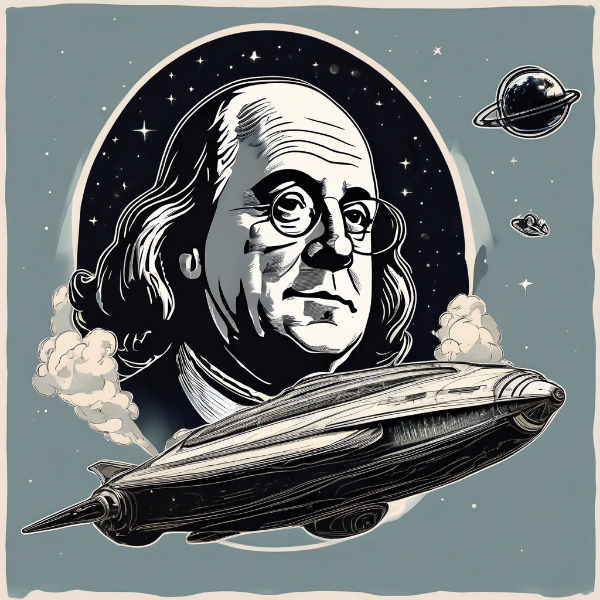
The flickering gaslight cast long, dancing shadows across the cobblestone street, illuminating the bustling heart of Philadelphia. Hidden amongst the ordinary townsfolk, a man named Benjamin Franklin walked with a peculiar grace, his eyes observing everything with an almost unnerving intensity. But beneath the guise of a brilliant inventor, statesman, and printer, lay a secret that could shatter the very foundations of the nascent nation he was helping to build. Benjamin Franklin was not from this world.
He remembered Xylos, the binary sunset painting the crystalline spires of his home city in hues of violet and gold. He remembered the hum of the gravitation engines, the taste of synthesized nutrient paste, and the feel of cool, smooth plasteel beneath his feet. He remembered, most of all, the devastation. A rogue comet, pulled from its orbit by a dying star, had struck Xylos with cataclysmic force. He was one of the few to escape, crammed into a small scout vessel with a rudimentary hyperspace drive, programmed to seek out a habitable planet and send back data. He had chosen Earth, drawn by its vibrant biosphere and the nascent intelligence of its dominant species.
His arrival had been… less than graceful. A crash landing in a remote forest left him disoriented and with a failing cloaking device. He discarded the wreckage, burying it deep within the earth, and took on the persona of an orphaned apprentice printer. He learned the language with astonishing speed, his advanced neuro-linguistic processors swiftly deciphering its complexities. He studied the customs, the beliefs, the aspirations of these humans, carefully observing their strengths and weaknesses.
He saw their potential. He saw their flaws. And he knew that he could help guide them, perhaps even steer them away from the self-destruction that had plagued so many civilizations across the galaxy.
So he became Benjamin Franklin. He embraced the life. He published Poor Richard's Almanac, filled with earthly wisdom and subtle philosophical prods. He invented the lightning rod, a feat of engineering that even his Xylossian technology recognized as remarkable for its simplicity and efficiency. He delved into the science of electricity, not just for its practical applications, but to understand the fundamental forces that governed this planet. He studied the human body, marveling at its intricate mechanics and frustratingly limited lifespan.
But it was in the realm of politics that Benjamin Franklin truly excelled. He witnessed the burgeoning discontent with British rule, the seeds of revolution taking root. He saw the passions, the ideals, the simmering rage, and he knew that these humans were on the cusp of something extraordinary. He used his influence, his wit, and his carefully cultivated reputation to navigate the treacherous political landscape. He urged moderation, he brokered compromises, and he subtly nudged the colonists towards independence.
He was a crucial figure in the Continental Congress, his unwavering optimism a beacon of hope in the face of seemingly insurmountable odds. He traveled to France, charmed the court, and secured vital financial and military aid for the American cause. He understood the power of diplomacy, the art of manipulating perceptions, the necessity of compromise. He used his Xylossian intellect to outmaneuver his opponents, always keeping the long-term goal in sight.
He drafted eloquent speeches, his words resonating with the ideals of liberty and self-determination. But in his private moments, writing in his heavily encrypted journals, he wrestled with the ethical implications of his actions. Was he truly helping these primitive beings, or was he merely imposing his own alien agenda? Was he guiding them towards a brighter future, or was he simply repeating the same mistakes that had led to the downfall of Xylos?
One evening, while contemplating these questions in his study, a strange signal pulsed through his implanted neural interface. It was a distress call, faint but unmistakable, emanating from deep space. Another Xylossian vessel, damaged and drifting, had stumbled upon Earth's solar system. They were in desperate need of repairs and supplies.
Benjamin Franklin froze. This was it. The moment he had long dreaded and secretly yearned for. A chance to reconnect with his own kind. A chance to return to the stars. But what about the humans? What about the nation he had helped to create? Could he simply abandon them now, after all that he had done?
He spent sleepless nights poring over star charts, calculating trajectories, and weighing the consequences of his decision. He knew that revealing his true identity could trigger widespread panic and chaos. He knew that his Xylossian technology, even in its degraded state, could be exploited for devastating purposes. But he also knew that he couldn't simply ignore the distress call. He was a Xylossian, and he had a duty to his people.
He devised a plan, a risky and audacious plan that would push his abilities to their limits. He would use his influence and resources to discreetly assist the stranded vessel, providing them with the necessary repairs and supplies without revealing his true identity. He would use his knowledge of Earth's resources and his understanding of human behavior to navigate the delicate situation.
He contacted the captain of a private merchant ship, a man he had previously helped with a discreet loan, and offered him a lucrative opportunity: to transport a shipment of rare metals to a remote location in the Atlantic. He provided the captain with precise coordinates and a complex set of instructions, ensuring that the rendezvous would be as discreet as possible.
Meanwhile, he worked tirelessly in his laboratory, modifying and repairing his own ancient cloaking device. He knew that he would need it to approach the Xylossian vessel undetected, to assess the situation and provide assistance.
The night of the rendezvous arrived. A storm raged, the wind howling like a banshee, the rain lashing against the ship's deck. He left a note for his housekeeper, explaining that he had been called away on urgent business, and slipped out into the darkness.
He used his modified cloaking device to reach the rendezvous point. The Xylossian vessel hung in the air, a ghostly silhouette against the storm clouds. He could see the damage, the flickering emergency lights, the frantic activity within.
He approached cautiously, transmitting a coded message, identifying himself as a Xylossian operative. A hatch opened, and he was ushered inside.
The crew was exhausted and demoralized. They recognized him instantly, their eyes widening in disbelief. “You… you are Benjamin Franklin?” the captain stammered.
“That is the persona I have adopted,” he replied, his voice resonating with the familiar cadence of Xylossian. “But I am also one of you.”
He spent the next few hours working alongside the crew, repairing damaged systems, providing medical assistance, and offering words of encouragement. He used his knowledge of human technology to jury-rig solutions, improvising with whatever resources were available.
As the storm subsided and the first rays of dawn appeared on the horizon, the Xylossian vessel was ready to depart. The captain approached him, his face etched with gratitude. “You have saved us,” he said. “We are in your debt.”
“I have done what any Xylossian would do,” Benjamin Franklin replied. “But my work here is not yet finished. I must remain on Earth.”
The captain looked at him with understanding. “You believe that these humans are worth saving?”
“I believe that they have the potential for greatness,” Benjamin Franklin said. “But they need guidance. They need direction. And I intend to provide it.”
The Xylossian vessel ascended into the sky, disappearing into the vastness of space. Benjamin Franklin watched them go, a complex mixture of emotions swirling within him. He was a Xylossian, but he was also Benjamin Franklin. And he had a destiny to fulfill on Earth.
He returned to Philadelphia, to his printing press, to his scientific experiments, to his political intrigues. He continued to shape the destiny of the fledgling nation, guiding it towards a future of liberty, equality, and self-governance. He remained a man of science, a man of letters, a man of the people. But beneath the surface, he was always something more, something alien, something extraordinary. He was Benjamin Franklin, the alien from Xylos, the architect of American independence, the silent guardian of a fragile planet. His secret remained safe, whispered only to the stars. And he continued to watch, to learn, and to guide, until the day he could finally return home, or until the humans were ready to inherit the galaxy.


Comments